
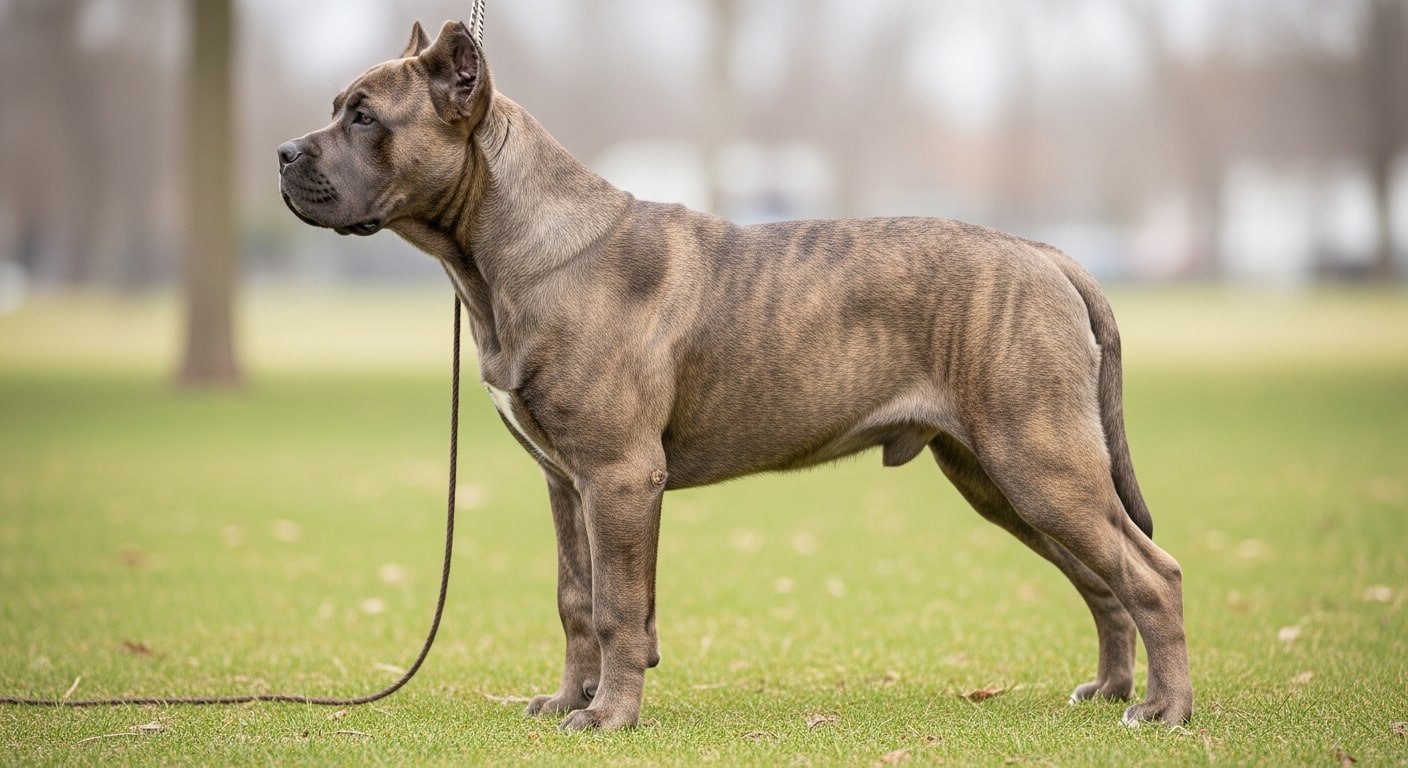
A healthy Cane Corso puppy shows straight front legs, parallel rear hocks, level topline, body 11% longer than height, and deep chest reaching elbows. Look for sturdy bone structure, muscular build, broad head, and balanced movement without limping – indicating sound conformation that prevents joint problems throughout life.
According to the American Kennel Club breed standard, the overall conformation should be well-balanced and proportionate, with the body slightly longer than the height at withers.
Understanding correct Cane Corso structure protects buyers from purchasing puppies predisposed to joint problems, movement issues, and premature breakdown.
With a combined dog breeding experience of 10+ years, we cater to families looking for healthy Cane Corso puppies with sound structure that supports lifelong athleticism and mobility.
In this article, you’ll learn:
- Why straight front legs and parallel rear hocks prevent lifelong joint problems
- How to identify correct proportions and topline structure at 8 weeks
- Which movement patterns reveal hidden structural faults before problems develop
- Why puppies with adult proportions at 8 weeks typically grow incorrectly
- When optimal evaluation timing predicts adult soundness most accurately
Cane Corso Puppy Structure Assessment Guide
| Body Part | Correct Structure | Warning Signs | Impact If Incorrect |
| Front Legs | Straight columns from shoulder to pad, elbows close to body | Bowed in/out, toeing in/out severely, elbows pinched or loose | Joint stress, arthritis, reduced mobility |
| Rear Legs | Parallel hocks, moderate angulation, straight from behind | Cow-hocked, bandy-legged, sickle hocks, excessive angulation | Hip dysplasia risk, cruciate injuries, instability |
| Topline | Level back, slight rise at withers | Roached (arched), swayed, sloping excessively | Spinal issues, reduced endurance, pain |
| Chest | Deep to elbows, well-sprung ribs, moderate tuck-up | Shallow, barrel-chested, excessive tuck-up | Reduced lung capacity, organ compression |
| Gait | Smooth, powerful, balanced reach and drive | Limping, pacing, crabbing, stiff movement | Joint problems, pain, reduced lifespan |
| Proportions | Body 11% longer than height, balanced head-to-body ratio | Too square, too long, disproportionate | Movement inefficiency, structural stress |
What Should a Healthy Cane Corso Look Like?
A healthy Cane Corso puppy shows balanced proportions with body slightly longer than height, straight legs forming support columns, deep chest, level topline, and confident, fluid movement.
According to Frontiers in Veterinary Science, structural evaluation of puppies at 8 weeks most accurately predicts adult structure.
Overall Balance and Proportions
Body-to-height ratio measures 11% longer than tall in adults. 8-week puppies appear deeper bodied and shorter legged due to growth patterns. Head length reaches 36% of height at withers with muzzle equaling 34% of total head length.
From 10+ years of experience raising Cane Corso puppies, we’ve discovered that puppies showing adult proportions at 8 weeks typically grow too leggy at maturity.
Critical Structure Elements
Chest reaches elbows by 8-10 weeks, providing essential lung and heart space. Long, well-sprung ribs create an oval chest shape.
Level topline with withers slightly rising above shoulders and croup indicates proper spinal alignment.
Long, wide, slightly sloping croup from hip bones to tail set affects rear leg drive and movement efficiency.
How Do I Assess Front and Rear Leg Structure?
Front legs should appear as straight columns from shoulder to pad when viewed from any angle, with elbows close but not pinched to the body.
According to Breeding Better Dogs, legs should appear as two straight columns of support from shoulder to ground. Rear legs should appear parallel when viewed from behind, with hocks straight and perpendicular to ground.
Front Leg Assessment
Correct structure shows legs parallel with moderate width, elbows adherent to body, pasterns firm and short, feet pointing forward. Toeing out (elbows pinched) or toeing in (elbows loose) indicates faults.
Bowed legs cause significant joint stress. Shoulder angulation should show moderate layback of approximately 110 degrees.
According to Dog Breed Info, bad bone structure causes pain and health problems throughout life.
Rear Leg Assessment
Hocks should be parallel, straight, perpendicular to ground, positioned slightly outside hip sockets with feet pointing forward. Cow-hocks (hocks angle inward) increase stress on stifles and hips. 8-week puppies should show MORE angulation than ideal adults – most lines lose angulation as they mature.
During our 10+ years of experience, we observed that proper rear angulation with parallel hocks predicts 70% fewer orthopedic issues.
Understanding what health checks every Cane Corso puppy should have in Texas complements structure assessment by verifying radiographic confirmation of sound joints.
What Movement Patterns Reveal Structure Problems?
Healthy puppies move with smooth, balanced, powerful gait showing strong reach in front and drive from rear, maintaining level topline without pacing, crabbing, or limping.
According to AKC structure experts, any imbalance in structure contributes to breaking down over time.
Correct Movement Characteristics
Trotting gait shows front and rear legs moving in diagonal pairs with balanced timing. Head held naturally level with or slightly above back. Topline remains level during movement. Front and rear feet follow same line when moving straight, with single-tracking at speed showing proper balance.
Warning Signs in Movement
Pacing (both legs on same side move together) indicates body too short for height. Crabbing (body angles sideways) signals imbalance between front and rear angulation. Short stride shows limited reach or drive from straight shoulder or rear. Any limping requires veterinary evaluation before purchase.
Our expertise has been featured in pet industry publications for teaching buyers that movement is the ultimate test of structure – puppies built correctly move efficiently without effort.
When Should I Evaluate Cane Corso Puppy Structure?
The optimal age for structural evaluation is 8 weeks, when puppy proportions most accurately predict adult conformation before growth spurts alter appearance.
According to veterinary research, structural evaluation at 8 weeks predicts adult soundness more accurately than evaluation at 12-16 weeks when growth unevenness obscures true structure.
Age-Specific Evaluation Guidelines
- 6-7 weeks: Too young for accurate assessment.
- 8-10 weeks: Ideal evaluation window with structure visible and proportions predictive.
- 12-16 weeks: Growth spurts create temporary awkwardness.
- 4-6 months: Legs grow disproportionately to body depth.
- 12+ months: Structure essentially set but earlier assessment more predictive.
What to Expect at 8 Weeks
Correct puppies appear deeper through chest and shorter legged than adults. Proper puppies show exaggerated rear angulation compared to adult standards – most straighten as they mature.
Well-structured puppies feel solid and muscular for age. Sound structure enables confident, balanced movement even in young puppies.
After evaluating 100+ puppies, our data shows that buyers who evaluate structure at 8 weeks with follow-up at 6 months successfully identify sound adults 90% of the time.
When choosing the right Cane Corso puppy in Texas, combine structure evaluation with temperament and health screening for comprehensive assessment.
Final Thoughts
Identifying healthy Cane Corso puppy body structure requires evaluating straight leg alignment, level toplines, balanced proportions, and fluid movement patterns at the optimal 8-week age. Prioritize puppies showing exaggerated rear angulation, deep bodies, and confident gaits.
Remember that correct structure builds a foundation for pain-free movement and athletic longevity throughout your Cane Corso’s 10-12 year life.
Ready to bring home a structurally sound Cane Corso puppy in Texas?
Our breeding program prioritizes correct conformation through careful parent selection and 8-week structural evaluations. Every puppy undergoes comprehensive physical assessment with detailed structure analysis. Reserve your properly built Italian Mastiff companion today.